
Thomson Reserve New Launch Guide. What Buyers Need To Know About The Neighborhood and Nearby Condo Prices Performance
Updated: 18 hours ago
A good Thomson address is not just about being near town. It is about the rare mix of greenery, old-school food streets, landed-home calm, respected schools, and MRT access that has become harder to find in one place.
That is why an upcoming project like Thomson Reserve will draw attention before its sales gallery opens. Buyers will ask whether it offers the quiet side of Singapore without feeling cut off. Investors will ask the sharper question: can a new launch in this part of the island hold its value against older condos nearby, and can it justify the price gap that new projects now command?
The short answer is that the Thomson, Upper Thomson, Marymount, Bishan, Ang Mo Kio and Lentor belt has shown steady buyer demand across market cycles. The better projects do not all move at the same pace, but they tend to share a few strengths: MRT access, family-sized catchments, greenery, and a mature resale pool.
This guide looks at the neighbourhood, nearby condo price performance within about 4 km, launch-to-current price comparisons, and the area’s public-facing celebrity appeal. Price figures below are broad indicative ranges based on commonly discussed launch benchmarks and market observations available up to recent public records and market reports. Always verify live transaction data through URA, caveats, and an agent with access to updated records before making a purchase decision.

Thomson Reserve sit in a part of Singapore with layered appeal
The Thomson name carries more than one meaning.
For some buyers, it means Upper Thomson Road, prata shops, bakeries, cafes, and supper spots that have been part of weekend routines for years. For others, it means MacRitchie Reservoir, Peirce Reservoir, Thomson Nature Park, and Windsor Nature Park. To families, it suggests schools, mature estates, and easy access to Bishan, Ang Mo Kio, Novena, Orchard, and the city.
That combination gives the area a different feel from many new-launch corridors.
It is not as polished as Marina Bay. It is not as mall-heavy as some regional centres. Its charm comes from being slightly unmanufactured. You have older shophouses, private landed enclaves, HDB estates, established condos, park connectors, and forested edges sitting close together.
For a new launch, that context matters. Buyers are not only buying a unit. They are buying into a daily rhythm.
A typical weekend in the area could include:
Breakfast along Upper Thomson Road
A walk at Windsor Nature Park or MacRitchie Reservoir
Grocery runs at nearby malls in Bishan, Thomson Plaza, or Ang Mo Kio
MRT trips on the Thomson-East Coast Line or Circle Line
A quieter evening back in a residential pocket
That is the main draw. Thomson feels central enough for convenience, but green enough to feel removed from the pressure of downtown living.
The neighbourhood charm comes from nature, food, and mature connectivity
Nature is the strongest lifestyle feature
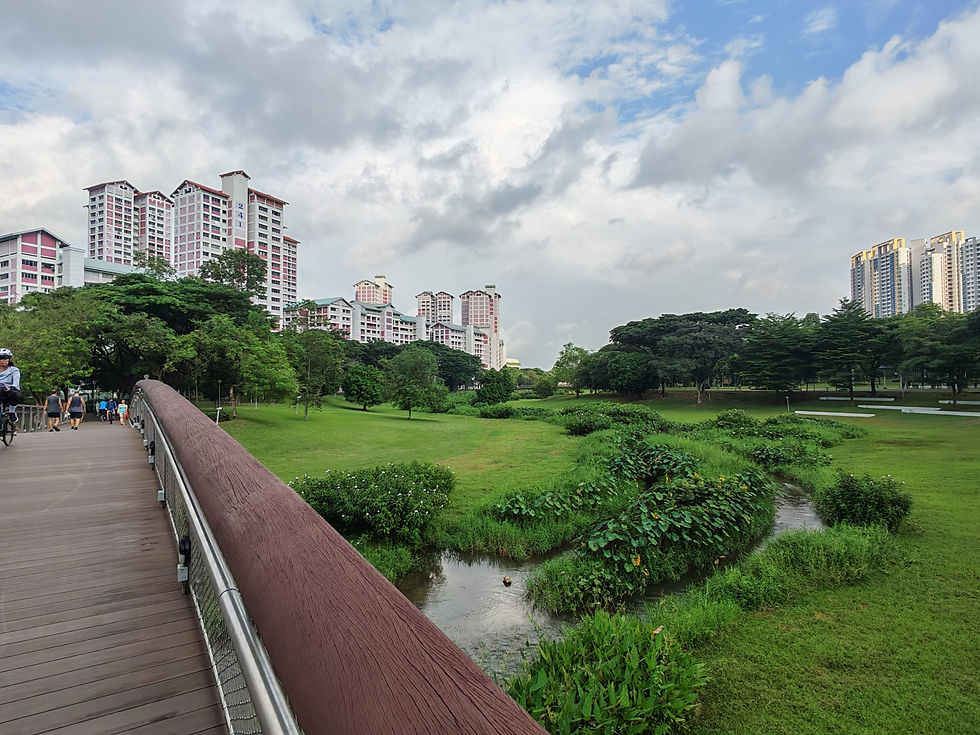
The Thomson area is one of the few city-fringe to mid-central locations where nature is not a token feature. It is part of the identity.
MacRitchie Reservoir is one of Singapore’s best-known green spaces, with trails, water views, and access to the Central Catchment area. Windsor Nature Park offers shorter trails and boardwalk sections. Thomson Nature Park adds heritage interest, with remnants of the former Hainan Village and forested paths that feel very different from manicured urban parks.
Lower Peirce and Upper Peirce Reservoirs add to the sense of space. They also make the northern side of the Thomson belt feel less dense than many mature estates.
For homebuyers, this has practical value. Green spaces support daily recreation, pet walks, children’s activities, and a sense of calm. For investors, it gives the location a softer scarcity factor. Singapore can build more malls, but it cannot easily recreate a mature nature belt beside established housing.
Upper Thomson Road gives the area its everyday energy
Upper Thomson Road has long been associated with food. It has a mix of old favourites, casual cafes, dessert spots, bakeries, and supper choices. The exact tenant mix changes over time, but the street keeps its pull because it serves residents from several nearby estates.
The area’s food culture also makes it easier for a new project to feel lived-in from day one. Residents do not need to wait for a managed retail podium to mature. The neighbourhood already has its own habits.
That matters because some new towns need years before they feel complete. Thomson, by contrast, already has the daily-use ecosystem that supports both owner-occupiers and tenants.
Transport has improved materially with the Thomson-East Coast Line
The Thomson-East Coast Line changed the way buyers read this location.
Before the TEL, parts of Upper Thomson felt car-friendly but less direct by train. Today, stations such as Upper Thomson, Bright Hill, Lentor, Mayflower, and Caldecott have improved rail access across the belt. Caldecott also connects to the Circle Line, which is useful for trips towards Botanic Gardens, Holland Village, one-north, Paya Lebar, and Marina Bay.
For drivers, the Central Expressway, Seletar Expressway, Lornie Highway, Marymount Road, and major arterial roads provide access across the island. Traffic can still build during peak hours, especially along popular food stretches and key junctions, but the area is no longer dependent on cars in the same way it once was.
The schools and estates create a deep buyer pool
The wider Thomson and Bishan-Ang Mo Kio catchment includes several well-known schools and education clusters. Families often watch distance rules closely, especially for primary school admission, so every project must be checked against the current Ministry of Education home-school distance tool rather than assumed.
Still, the general point stands. The area is near established family estates. Bishan, Ang Mo Kio, Marymount, Sin Ming, and Upper Thomson have long attracted households that want practical amenities without moving too far from central Singapore.
This helps resale liquidity. A project in this belt can appeal to:
Families upgrading from nearby HDB flats
Private property owners rightsizing within the same district
Tenants who work in the city, Novena, one-north, or the north region
Buyers who want greenery but do not want an outer-suburban feel
Nearby condo price performance within about 4 km shows steady long-term demand
The 4 km radius around a likely Thomson or Upper Thomson new launch pulls in a broad set of comparable projects. It includes older resale condos in Upper Thomson and Sin Ming, large projects in Marymount and Bishan, and newer launches in Ang Mo Kio and Lentor.
That mix is useful. It shows how different buyer segments price the area.
Older condos show the long-term value of the location. Newer launches show where replacement-cost pricing has moved. Integrated or near-MRT projects show how much buyers pay for convenience.
The table below is best read as a market map, not a valuation report. Price bands vary by unit size, floor, facing, renovation, stack, tenure balance, and transaction date.
Development | Approximate area | Tenure | Launch period | Indicative launch price range | Indicative current price range | Broad performance reading |
Thomson Grand | Upper Thomson | 99-year leasehold | Around 2011 | About S$1,150 to S$1,300 psf | About S$1,550 to S$1,850 psf | Clear uplift from early-2010s entry prices, supported by location and scarcity |
Thomson Three | Bright Hill, Upper Thomson | 99-year leasehold | Around 2013 | About S$1,300 to S$1,450 psf | About S$1,650 to S$1,900 psf | Healthy gains, with MRT access improving its resale story |
Thomson Impressions | Lorong Puntong area | 99-year leasehold | Around 2015 | About S$1,350 to S$1,500 psf | About S$1,600 to S$1,850 psf | More modest but still positive performance, helped by boutique supply |
JadeScape | Marymount, Shunfu | 99-year leasehold | Around 2018 | About S$1,650 to S$1,800 psf | About S$2,000 to S$2,300 psf | Stronger performance from scale, MRT proximity, and newer facilities |
Sky Habitat | Bishan | 99-year leasehold | Around 2012 | About S$1,500 to S$1,650 psf | About S$1,700 to S$2,000 psf | Gains were more measured due to a higher initial launch benchmark |
The Panorama | Ang Mo Kio | 99-year leasehold | Around 2014 | About S$1,200 to S$1,350 psf | About S$1,600 to S$1,900 psf | Good uplift from a lower base, supported by family demand in Ang Mo Kio |
AMO Residence | Ang Mo Kio Rise | 99-year leasehold | Around 2022 | About S$2,000 to S$2,250 psf | Limited resale, broadly above launch for many stacks | Shows where prime Ang Mo Kio new-launch pricing has moved |
Lentor Modern | Lentor | 99-year leasehold | Around 2022 | About S$1,900 to S$2,200 psf | New sale and early resale references broadly above launch | Integrated MRT positioning helped set a new Lentor benchmark |
The broad pattern is clear. Many nearby projects launched in the early to mid-2010s at prices that now look low compared with current new-launch benchmarks. Projects that entered the market around S$1,200 to S$1,500 psf have generally seen meaningful uplift. Projects that launched at a premium from day one still appreciated, but their gains were usually more measured.
The key lesson from nearby condos is simple: entry price matters, but in Thomson, location quality has helped many projects protect value over time.
What the launch-to-current comparison says about Thomson Reserve
The most useful comparison is not simply “old price versus new price”. A buyer should ask why prices moved.
Early-2010s launches benefited from a lower land-cost era
Projects such as Thomson Grand, Thomson Three, Sky Habitat, and The Panorama came to market when construction, land, and replacement costs were far lower than today. Their launch prices now act as reminders of how much the private residential market has moved over the last decade.
That does not mean a new launch should be cheap. It means buyers need to judge whether the premium is justified.
A new project like Thomson Reserve will likely compete on:
Efficient unit layouts
Newer facilities
Fresh lease tenure if it is leasehold
Better smart-home and sustainability features
Lower near-term maintenance concerns
Appeal to buyers who do not want older resale renovation work
These are real benefits. But they must be priced sensibly against resale alternatives.
MRT and nature premiums are both visible in the area
JadeScape’s performance shows how the market rewards a large, well-located project with MRT access and full condo facilities. Lentor Modern shows the draw of integrated convenience at an MRT station. Thomson Three benefited as Bright Hill and TEL connectivity became more relevant.
Thomson Reserve’s eventual pricing should be read against its exact walking distance to MRT, road noise, stack orientation, unit mix, and project scale. In this part of Singapore, a small difference in micro-location can affect demand.
A project closer to greenery may feel more exclusive. A project closer to MRT may rent more easily. A project closer to Upper Thomson Road may offer better food and daily convenience, but buyers may also check traffic and noise.
Older resale condos still matter as competition
New-launch buyers sometimes compare only against other new launches. That can be a mistake in Thomson.
A family looking for space may compare a compact new three-bedder against a larger resale unit at Thomson Grand, Thomson Three, The Panorama, or Sky Habitat. If the resale unit offers more liveable space for the same quantum, it can become a serious alternative.
At the same time, resale condos may require renovation, have older facilities, and face lease decay. Buyers also need to look at maintenance, sinking fund health, layout efficiency, and future exit demand.
For Thomson Reserve, this means the strongest sales pitch will not be “new is better”. It will be new, well-located, efficiently planned, and priced within reason against proven neighbours.

Nearby projects reveal three buyer segments Thomson Reserve must win
Owner-occupiers who want the Thomson lifestyle
This group is likely to focus on daily convenience and liveability.
They will compare:
Distance to MRT
Food and grocery options
Nature access
School distance
Unit layout
Noise levels
Carpark access and road flow
Long-term comfort for children or ageing parents
For them, Thomson Reserve’s success will depend on whether the homes feel practical. A beautiful showflat can attract attention, but buyers in this area often care about storage, kitchen usability, yard space, ventilation, and whether bedrooms fit real furniture.
Investors who want rentability with capital preservation
Investors will look at tenant pools.
The Thomson belt can attract tenants who work in the city, Novena medical area, Bishan, Ang Mo Kio, one-north via the Circle Line, and northern employment nodes through the TEL and road network. It may not deliver the same rental intensity as the CBD or one-north fringe, but it has broader lifestyle appeal.
For investors, the main risk is entry price. If Thomson Reserve launches at a wide premium over nearby resale projects, rental yield may compress. That is common for new launches, especially in land-scarce areas. The bet then shifts to long-term capital preservation and future resale to owner-occupiers.
A sensible investor should model:
Expected rent by unit type
Maintenance fees
Property tax
Interest cost
Buyer’s Stamp Duty and Additional Buyer’s Stamp Duty if applicable
Vacancy allowance
Exit price needed after selling costs
This article is for general information only and is not financial advice. Property purchases involve policy, financing, and market risks.
HDB upgraders from Bishan, Ang Mo Kio, and Sin Ming
This is a powerful group. The nearby mature HDB estates have many households with roots in the area. Some may want to upgrade without leaving their parents, schools, workplaces, or religious and community networks.
For these buyers, total quantum often matters more than psf. A two-bedroom plus study, compact three-bedroom, or efficient family unit can perform well if it fits real budgets.
Thomson Reserve should watch this segment closely. If units are too large, quantum rises beyond the upgrader pool. If units are too small, families may choose resale condos instead.
How Thomson Reserve could position itself against nearby launches
Because official launch details may still be pending, buyers should avoid forming a fixed view too early. The project’s attractiveness will depend on site plan, unit mix, developer track record, launch pricing, and the wider market mood at launch.
Still, the surrounding comparables suggest several likely positioning angles.
If it prices close to newer benchmarks
If Thomson Reserve prices closer to recent new launches in Ang Mo Kio or Lentor, buyers will expect a strong product. That means excellent layouts, refined landscaping, good facilities, and clear transport convenience.
At higher price points, buyers become less forgiving. A poor-facing stack, awkward layout, or long walk to MRT can be harder to justify.
If it prices at a modest premium over resale stock
This would be the most appealing scenario for many buyers. A new launch with a fresh lease and modern facilities at a reasonable premium over nearby resale condos could attract strong demand.
The challenge is whether land and construction costs allow that. New launches in Singapore have faced rising cost pressure, so a bargain is unlikely. The question is whether the price feels fair compared with the alternatives.
If it offers rare layouts or low-density appeal
The Thomson area can support premium products if they offer something scarce. Larger family units, private lift stacks, nature-facing homes, low-density design, or strong landscaping could stand out.
This is especially true for buyers moving from landed homes or older large condos who want a newer product without losing too much space.
A Charming Area Surrounded by Future Potential Enbloc Developments and Good Food.
The Thomson, Caldecott, Bishan, and Upper Thomson belt has long had a public association with large developments, surrounded by nature reserve and local good food.
This location has a rich food culture that now forms a certain cultural memory. Many Singaporeans will still remember the Long House", a major eatery nestled in a coffee shop that was once a landmark whenever one think of good food around the Upper Thomson area. The row of old shophouses also features famous chicken rice and curry rice among some of the local delights.
In prestige terms, this can still help. Locations with privacy, greenery, and convenient access tend to attract high-profile residents over time. Thomson has those ingredients. It offers the kind of lifestyle that appeals to people who want to be near town without living in a high-visibility shopping belt district.

What buyers should check before committing to Thomson Reserve
A good address can still be a poor buy if the unit selection is wrong. Before booking a unit, focus on the following checks.
Confirm the exact site advantages
Do not rely on the name alone. Check the walk to the nearest MRT station at street level, not just on a map. Look for traffic crossings, slopes, sheltered routes, and night-time lighting.
Also check:
Main road exposure
Distance to food streets
Distance to nature parks
Future construction nearby
School distance boundaries
Bus options
Peak-hour road flow
A unit that looks close to everything on paper may feel less convenient in daily life if the walking route is poor.
Compare unit quantum, not only psf
Psf is useful, but buyers live with the total cheque.
A S$2,400 psf compact unit may look expensive beside a S$1,800 psf resale condo, but the total quantum could still be manageable. The opposite can also happen, where a lower psf resale unit costs more because it is much larger.
Compare by use case:
One-bedroom units for rental flexibility
Two-bedroom units for singles, couples, or investors
Three-bedroom units for families and HDB upgraders
Larger units for multi-generational buyers or rightsizers from landed homes
The best-value stack is not always the cheapest psf. It is the one with the clearest future buyer pool.
Study the resale exit audience
Every purchase should have a likely future buyer.
For Thomson Reserve, the exit audience may include families, nature lovers, HDB upgraders, professionals using the TEL, and buyers who want a central-north home with a calmer feel.
A unit with an odd layout, poor facing, or high quantum may shrink that audience. A unit with efficient space, good light, and practical bedroom sizes may sell more easily even if its entry psf is not the lowest.
Watch the new-launch premium
New launches often look expensive beside older neighbours. Some premium is fair. The buyer gets new facilities, a fresh lease, progressive payment structure for buildings under construction, and less immediate renovation work.
The danger is overpaying for novelty.
A healthy way to judge the premium is to ask:
How much more am I paying over nearby resale condos?
What do I get in return?
Will future buyers see the same value?
Can rental demand support part of the premium?
Does the unit still make sense if the market stays flat for a few years?
If the answers are clear, the premium may be justified. If the answers rely only on hope, step back.
The investment case rests on scarcity, not hype
Thomson Reserve’s strongest investment argument is not that every new launch in the area must rise. No project is guaranteed to perform.
The stronger argument is that the Thomson belt has hard-to-replicate qualities. It has mature amenities, meaningful greenery, transport upgrades, family demand, and a limited number of large private residential sites compared with more supply-heavy corridors.
Nearby condo performance supports this view. Many developments within about 4 km have moved above their launch benchmarks, especially those bought before today’s higher replacement-cost environment. Newer projects have also shown that buyers will pay higher prices for strong connectivity and modern design.
The risk is that future gains may be slower if entry prices are already high. Buyers should not assume that the next decade will repeat the last decade’s gains at the same pace. Interest rates, cooling measures, supply, rental conditions, and household affordability all matter.
For owner-occupiers, Thomson Reserve may be attractive if it delivers a home that improves daily life. For investors, it needs sharper numbers, especially rental yield, entry price, and exit liquidity.

The takeaway for Thomson Reserve buyers
Thomson Reserve deserves attention because the area is genuinely hard to copy. It offers nature without giving up city access, mature amenities without feeling overly commercial, and a neighbourhood identity that goes beyond a single mall or MRT station.
The nearby price record is broadly supportive. Many condos within about 4 km have risen from their launch benchmarks, with stronger results where entry prices were reasonable, MRT access improved, or project attributes stayed relevant to families and tenants.
The best approach is to stay disciplined. Compare Thomson Reserve against Thomson Grand, Thomson Three, Thomson Impressions, JadeScape, Sky Habitat, The Panorama, AMO Residence, and Lentor Modern by quantum, layout, tenure, transport, and future resale audience. Treat celebrity-resident claims with caution, but recognise the wider Thomson and Caldecott belt’s appeal to people who value privacy, greenery, and convenience.
If the launch price is fair for its location and product quality, Thomson Reserve could become one of the more watched residential opportunities in the central-north region. If the premium runs too far ahead of the resale market, buyers should choose their stack and unit type with extra care.
A good Thomson home is bought with both heart and spreadsheet. The heart understands the charm. The spreadsheet decides whether the price makes sense.
Do connect with us to receive more information about Thomson Reserve on its pricing and stack analysis.


